2026-07-13
Where's the Chat GDP?
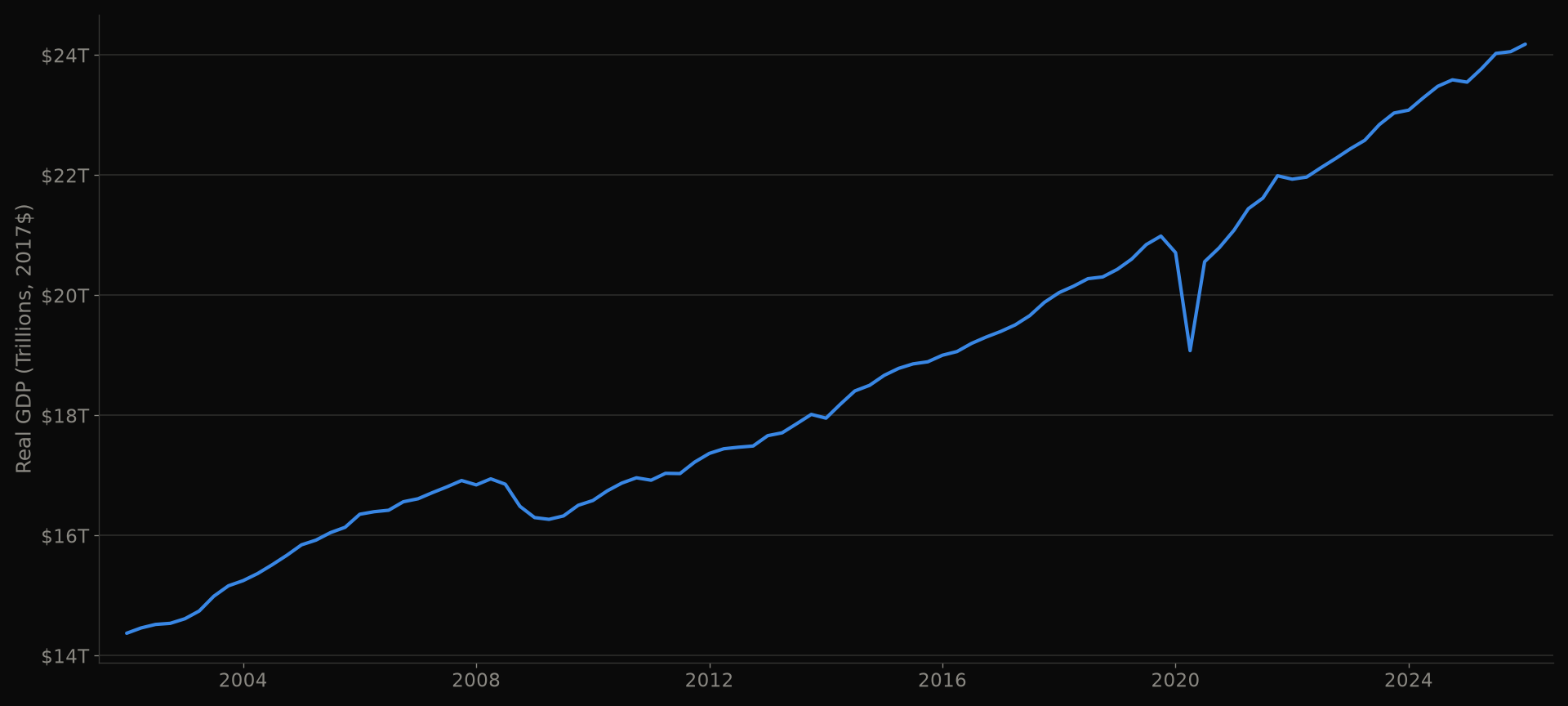 Can you spot when generative AI arrived? Me neither.
Generative AI is magical and amazing, has been mainstream for 3.5 years and reliably usable for many real business tasks for at least a year and a half. Why then hasn't US GDP so much as budged from its trajectory? I've got effectively free human-level intelligence in my pocket, on demand, anytime, anywhere. How can that possibly not have affected economic output?
Well, basically for the same reason the internet didn't cause GDP to spike. The internet made long-distance communication dramatically cheaper. But it wasn't the first technology that allowed fast communication across long distances. The telegraph had existed for about 150 years. Transmission of currency and commodity prices between New York and London had been occurring in some form since the 1860s, gradually improving in latency and bandwidth. Relaying of the most important news stories was accomplished with wire services and broadcast transmissions. The highest-value needs for fast long-distance communication were already being met.
Where the internet really moved the needle was in the lower-economic value use cases. It became possible to read about the daily life of an Australian beekeeper (if one happened to blog about it) or to share a video of a monkey sniffing its finger (if you know, you know) with all of your friends almost instantly. If the benefits of these new activities could even be measured, they wouldn't add as many points as, say, farmers in the US Midwest receiving news of a failed wheat harvest in Argentina. This meant a much bigger impact on culture and people's daily lives than on economic statistics.
What about the brand new companies — Amazon, Google, and such? How could they grow to be trillion dollar companies without creating a lot of measurable economic value?1 True, they created real value, but their rise was as much a shuffling of value as outright creation. The rise of Amazon was partially offset by the decline of Sears, that of Google by the decline of print newspapers, so their net effect was muted by the destruction of other companies' value.
Generative AI makes intelligence dramatically cheaper. But just as with communication, the most economically valuable applications of intelligence have already had plenty of intelligence thrown at them. Human intelligence. Exxon Mobil and Walmart have for decades had thousands of engineers, statisticians, and finance professionals applying their brainpower to optimize operations — specifically because it's so valuable that it has been worth employing thousands of humans to do it.
Today at least, Generative AI is mainly being used to do things which humans could always do, but which it wasn't quite worth paying a human to do. I can have a detailed plan created for planting and caring for a raised bed garden in central Maryland. Or have my employment agreement reviewed and flag sections I should read carefully or consult an attorney about. AI can instantly suggest foods which naturally provide iodine if I'm not using much iodized salt. Or, of course, do your kid's math homework. But the GDP impact of these uses is not dramatic: a few onion bulbs and packs of dried seaweed which would likely otherwise have gone unpurchased.
What about all the new code AI is writing? Same story — it's not the most economically useful code. Not because AI code is crap, but because the most economically useful code was already being handled. We already had code to process CT scans and control the conveyor belts in manufacturing facilities. What AI code generation specifically unlocks is the long tail of applications that weren't quite worth writing under 100% human programmer economics.
The good news is, some of those applications will really matter to individual people! And some businesses that weren't financially viable a few years ago suddenly are reasonable. Middle school music teachers in rural areas wouldn't have formed a big enough market to support a dedicated app; now they probably do. And existing businesses and organizations will be able to get to items much further down on the to-do list than previously.
However, just as with the internet, the most immediate impacts of Generative AI are cultural rather than economic. Even within the realm of what's dollar-measurable, we will see a tablespoon of value creation and two cups of value transfer. In the public markets right now, it looks like a lot of value being transferred from SaaS providers to semiconductor manufacturers and anyone involved in data center construction2, but I doubt that will be the last such story.
Gen AI will make economic activity more efficient, but it will happen gradually, and primarily through substitution rather than brand-new capability. Some (most?) of the work being done by those data analysts and engineers at Walmart and Exxon will be shifted to AI agents and workflows which can do those tasks more cheaply. That will free up those people to do other work. I don't know exactly what that other work will be, but as long as it's even marginally valuable, it will mean increased productivity statistics.
In retrospect, economists generally agree that the IT boom did increase US productivity, by something like 10% over the decade from the mid-'90s to the mid-aughts. But that took ten years, and over that period technology changed other aspects of life by much more than 10%. I expect the AI boom to do the same on both counts.
Footnotes
-
Yes, I know company market cap is a stock, and GDP is a flow, and the two aren't directly linked in any case. Replace "market cap" with "revenue" if you want a closer fit. ↩
-
Data center construction is in fact the one area where AI spending is visibly showing up in GDP, but that's investment spending, not an increase in widget production, and in any case it still isn't obviously moving the trend line. ↩